This short post is written in response to a frequently asked questions about what sort of home battery configuration is best to adopt. When you selecting a battery set-up for your solar, there is choice between a DC coupled or an AC coupled system.
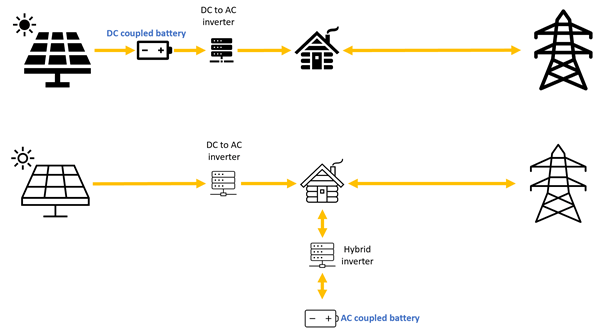
DC Coupled – a system that will store direct current (DC) from your solar into a battery then convert this into alternating current (AC) through an inverter for use to then run appliances in the house. Once the battery is full, excess energy can be exported to the grid however you cannot charge the battery from the grid with this system and you cannot run your house in island mode (if there was a grid blackout you wouldn’t e able power the house even if the sun was shining).
AC Coupled – a system that will convert DC from your panels into AC for the house to use but if there is surplus another inverter converts this to DC for storage in the battery and can convert this back to AC again should the battery need to discharge. This system can export excess into the grid but is also capable of importing grid electricity to charge the battery (useful for accessing cheap off peak electricity during winter). AC coupled systems can be setup to operate as back-up in case of a power cut (island mode) but make sure you discuss this with your installer/supplier to make sure the what you are getting is capable and will be setup as such.
Whilst planning for our installation we considered going for battery only (no solar), thinking we could get a decent sized Tesla Powerwall (12kWh). The idea was that we could fill the battery using off-peak electricity such that the our house consumption of 8kWh/day only ever drawn from the battery. The EV would continue to be charged off-peak from the grid. The AC Coupled system has the flexibility to do this however the downsides are:
- it requires a few more components and hence additional cost to implement (but certainly not prohibitively so).
- This type of system has more losses, primarily because there are more conversions each time the source or the load changes (i.e. from Solar DC to AC then from AC to DC battery then from Battery DC to the house AC). Whilst these are legitimate system losses, we didn’t think this was significant enough to avoid and are very pleased with the set-up we have.
One of the suppliers to quote us for solar and battery was EON, their proposal ticked all the boxes and their professionalism was a cut above the rest but they only offered a DC couple system. It was mainly this reason that we decided against their system.

 3nergyTech