One of the key questions that most people will ask during their research of solar is how do I calculate the system size I need. There are various methods and I will share the approach that is currently taken by MCS standards organisation (MCS – Micro-generation Certification Scheme). MCS they create and maintain the standards for installers and their installations in this UK and their also own the certification scheme (for insurance purposes etc make sure that your installers is acrredited under MCS). In summary the MCS steps are as follows :
1.Establish the electrical rating of the PV array inkilowatts peak (kWp)
2.Determine the postcode region
3.Determine the array pitch
4.Determine the array orientation
5.Lookup kWh/kWp (kK) from the appropriate location specific table
6.Determine the shading factor (SF)Using shade factor procedure.
If you are new to all of this, then there are two broad approaches to take:
- Let your prospective installers decide for you (just to be clear, I don’t like this approach). Approach a number of solar installation companies to get quotes and use these to determine what is appropriate based on what they tell you and comparing the quotes. I recommend you only approach installers who are MCS certified. If they wish to provide you with a quote, these are supposed to be non-binding make sure they know that you know that (otherwise like other fledgling industries some will try to pressure you into buying even when you’re not ready or comfortable). What I don’t like about this approach is that it puts the design of your system in the hands of people who are selling to you which means that they are less likely to make those little tweaks that may be required to really tailor this installation to you (it is like getting your kids to do the garden work, they can do a good job but it will be more thorough if you are telling them exactly what you want).
- Calculate what you need and evaluate suppliers against this. I recommend that you take this approach if you can. This way, you can even determine and work out costs of panels, inverters etc ready to go into discussions with suppliers with full understanding of what you need the system to be capable of (it also means you can smell if a supplier is not fully forthcoming with details!)
How to calculate your requirements (I recommend using a spreadsheet so that you can easily check out a few options easily). We need to complete the following calculation;
Estimated Annual Output (kWh/yr) = Array size (kWp) x Solar Radiation Input Factor (kk) x Shade Factor (SF)
The steps below will help you put the calculation together.
- Understand what your energy usage is. This means looking at your electricity bills to see how much energy you use of the course of a year. If you are thinking of getting an EV (electric vehicle) then you should add the estimated yearly energy usage for this on this and Convert this to daily consumption by dividing by 365. For example: your bill might say you use 3,000kWh/year and your EV use might add another 6,000kWh/year to make a total of 9,000kWh per year then divided by 365 to make it 24.7kWh per day.
- Estimate the approximate number of panels that can be fitted on your roof. The standard size commonly applied to roof fitted solar panels is 1.7m^2 (that is 1.698m x 1.004m). Calculate the area of roof space you have and divide by 1.7m^2 to get the most number of panels you can fit. For example, if the area of your roof is 9m x 5m = 45m^2, divide 45 by 1.7m to give you 26.7, this means that you can fit approximately a maximum of 26 panels.
- Array size. This bit can be adjusted together with the number of panels to get the best maximum generation combination for you. Array size (kWp) = Panel Output (W)x Number of Panels. Use a range of panel outputs to for an initial rough idea of achievable array size and cost (note that the costs calculated this way do not include the install labour rate and these will differ by company!). Go to a supplier website such as Midsummer to get some panel output and costs. To get you going try the following panel outputs as a range, 305W, 325W, 365W, 390W and you should now have something like this.
- Solar Radiation Input Factor (kk). Depending on where you live in the country (or indeed the world), the amount of ‘sun’ or radiation input received is different. This is because the earth travels around the sun at ‘an angle’ which changes slight depending on time of year (hence summer to winter variations). The area (aka the zone) you live will have a ‘typical amount of sun it receives’ but three other important factors to determine the performance of a solar system on your roof are (a) Azimuth aka which direction your roof is facing (specifically it’s orientation from the south). South is 0 degrees, West is 90 degrees and East is -90degrees (get your compass/iPhone out and work it out!) (b) the angle/pitch of your roof. (If you don’t have plans for your house that tell you this then you’ll need to do a bit of Trigonometry and Pythagoras!). I’ll share a further guide on how to work this out more accurately but if you are completely lost at this point use 35 degrees (between 30 degrees and 40 degrees is considered good for rooftop solar) but remember to come back and correct this after working it out later! (c) Finally you need to work out which zone you are in and take note of your zone/area number, do this by looking at this chart. We will now be able to use this information to determine the Solar Radiation Input Factor by using a look-up data table, the Solar Irradiance data sets from the MCS website. All you have to do with this open the tab with the zone corresponding to your area. For example if your house is in Birmingham select the tab with Zone6 (you can delete/ignore all other tabs). Now highlight the column that matches you orientation (angle from the south) and the highlight the row that matches the pitch/slope of your roof (e.g. 35 degrees). Where the two highlighted areas intersect is your Solar Radiation input factor (kk), here is an example of what this looks like.
- Shade Factor. The ideal location for solar panels is where they don’t get any shade at all (e.g. shade could be from trees, chimney, satellite dish etc). If you don’t have any shading the use 1 for this part of the calculation. but if you have shade, we suggest you consider if this can be avoided or removed but if not please follow the steps here and here (both are on the MCS website).
- Estimated annual Output (kWh). Finally, we can now complete the calculation to estimate the annual output (kWh) of the system we are designing. Estimated Annual Output (kWh/yr) = Array size (kWp) x Solar Radiation Input Factor (kk) x Shade Factor (SF)
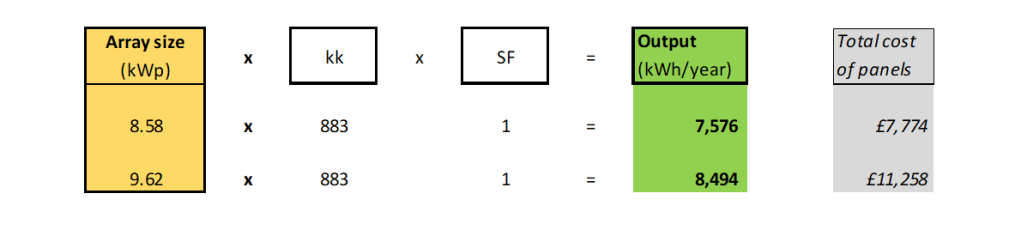
With the output above you can now see how this compares with what you think you electricity needs will be for the year and you can now play with the numbers to get what you need. If you need a higher output you could look at adding more panels (but in our example above we had already maximised at 26panels!) or you could go for the higher out put panels (e.g. instead of 370W panels get 390W). Or if cost is over your budget reduce number of panels or go for a different brand etc (note that the costs calculated this way do not include the install labour rate and these will differ by company!).
Whatever a supplier quotes you, should match your own calculations as above but you don’t have to feel guilty about asking them to tweak things because you can do it yourself. If they want you business hopefully they will give you a quote to match each scenario so that you get what you need.
I will follow up with a video walk-through of all the above but for now here is an overview of our own system.

 3nergyTech
2 thoughts on “How to determine the appropriate solar array size to install?”