Over the last 10years solar in the UK took off at quite a pace mainly with thanks to the UK governments FIT (Feed in Tariff scheme). The FIT scheme made payback of solar installations in domestic settings much quicker and very lucrative for those able to participate. The scheme officially closed to new entrants on the 1st April 2019.
I have just recently (Feb 2020) installed 18 solar panels (325W each) plus a 6.5kWh hour battery and it has been interesting to see the system take shape. Below is a summary but look out for more details and updates in the blog.
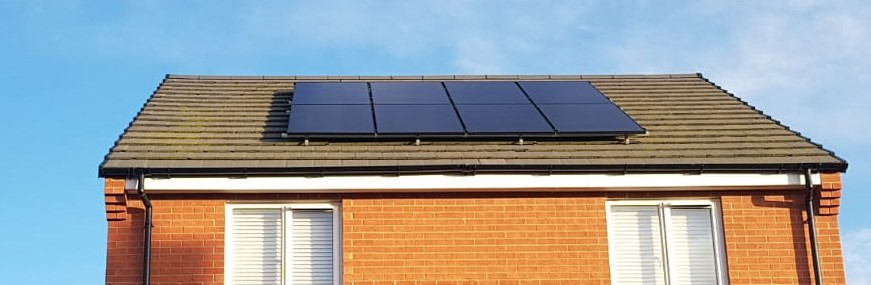
Having recently acquired an EV, we determined that our home electricity bill was ow likely to at least double from 3,000kWh per year to 9,000kWh per year. This was still going to be a lower fuel cost for because we had got rid of one of our diesel cars. We decided that we would like to reduce the environmental impact further (and hopefully costs along the way) by installing solar. We calculated that for our area we could generate at least 4,000kWh per year and we could get a lot of satisfication knowing that nearly half our home consumption for the year is self generated.
We both work and with school, it means the house is empty during the day so we needed to work out how we can store solar so that we make use of it when we return from work in evening. This is when requirement for a battery came into play. Yes off course… the Tesla Powerwall was our first choice! but budget soon brought that dream crashing down. For us, the higher the capacity the better but looking for at least 6kWh of storage enough to ensure that daily house usage would be covered (excluding the EV), we also needed the battery capacity to be expandable in the future and a decent monitoring system. We installed a GivEnergy 8.2kWh battery (usable capacity is 6.5kWh), look out for details on why we took this option in the blog.
Overall it was also important for us that we could charge the battery from the grid at specific times if we needed to (we know that solar generation is poor in the winter and hence would need to take advantage of cheaper Octopus Go night time tariffs instead, see blog for more details – referall link: https://share.octopus.energy/sky-lark-695)
In January 2020 the Smart Export Guarantee (SEG) scheme went live https://www.ofgem.gov.uk/environmental-programmes/smart-export-guarantee-seg/about-smart-export-guarantee-seg:
The SEG is an opportunity for anyone who has installed one of the following technology types up to a capacity of 5MW, or up to 50kW for Micro-CHP:
- Solar photovoltaic (solar PV)
- Wind
- Micro combined heat and power (CHP)
- Hydro
- Anaerobic digestion (AD
In short, this scheme means that if you generate solar you can get paid for any energy you export onto ‘the grid’. All suppliers with over 150,000 domestic customers are required to offer a SEG tariff even if they are not your supplier and their tariff must be over 0 pence per kWh. Our initial research showed a variation between suppliers but a fixed export payment of £0.053 per kWh appeared to be on the higher end of available fixed tariffs in February 2020 (see Bulb energy 5.38p/kWh March 2020: https://help.bulb.co.uk/hc/en-us/articles/360038160851-Getting-paid-for-exported-electricity) It was not possible at the time of writing to be on the Octopus Go tariff as well as their SEG tariff (Outgoing Octopus – https://octopus.energy/outgoing/)
One of the opportunities created by the SEG is that if like me you are at work during the day, if you export your solar generated energy at £0.05 per kWh it means if you are on Octopus Go you can essentially get all this energy back also at £0.05 per kWh between 00:30 and 04:30 which means you are cost neutral and have essentialy used the grid as a form of storage for your solar generated electricity (if you can charge your EV and Battery).
Please follow the blog for further details of our systems, research ideas and comparisons of options, technology and systems that are available.
 3nergyTech
Very interesting.
LikeLike
Thanks Phil 🙂
LikeLike
Thanks for this interesting commentary on your experience of solar power generation and storage in the home. It would be interesting to understand if there could be any economies of scale introduced by spreading this technology into neighbouring households who can then share a common battery source /solar panels. Albeit they would not have the same grid connection.
LikeLike